

By Baldomero Garza, Co-Founder, MSW Nutrition
You went to bed at a decent hour. You slept eight hours. And you still woke up feeling like you got hit by a truck. So you reach for coffee, and by two in the afternoon you're dragging again — and somewhere in the back of your mind a quiet worry starts up: is something wrong with me? If you keep asking why am I always tired despite doing everything right, the answer usually isn't sleep. It's what's happening one level deeper, at the cellular level, where your body actually manufactures energy.
Why sleep alone doesn't fix exhaustion
Sleep is an input, not the whole system. It's the window during which your body repairs — but repair still requires raw materials. If the nutrients that build your neurotransmitters, run your antioxidant defenses, and fuel your mitochondria aren't there, no amount of time in bed will manufacture them.
Think of your body the way you think about a car. It needs the right inputs to run, and when it doesn't get them, performance drops long before anything looks broken. That's the honest reframe here: you're not lazy and you're not broken. You're most likely running low on something measurable. Below are the five most common culprits — and unlike vague fatigue advice, each one shows up on a blood panel.
Reason 1: You're malnourished, not lazy
Most people hear "vitamin deficiency" and picture the textbook extremes — scurvy, rickets. The everyday version is far more common and far less dramatic: you're just tired, foggy, and flat.
Vitamin C is a good example. It's known for collagen and immune support, but it also acts as a cofactor for dopamine-beta-hydroxylase, the enzyme that converts dopamine into norepinephrine — the neurotransmitter behind focus, drive, and motivation. Run low, and it isn't only your immune system that notices.
Vitamin D3 is one of the most common deficiencies worldwide, and it affects mood, immune regulation, and bone density. It also needs vitamin K2 alongside it: D3 and K2 are what direct calcium into bone rather than soft tissue, which is why calcium supplements alone often disappoint.
Then there are the minerals quietly running hundreds of reactions a day:
- Zinc and magnesium — involved in hundreds of enzymatic reactions tied to energy, sleep, and hormone production.
- Selenium — concentrated in the liver and essential to thyroid hormone conversion and antioxidant enzymes.
- Chromium — long studied for its role in blood sugar and insulin sensitivity.
- Manganese — the one almost nobody mentions, despite its documented role in brain function, bone formation, wound healing, and blood clotting.
And underneath all of it: electrolytes. Sodium, potassium, chloride, calcium, and magnesium are what let your cells actually do their jobs. Sweat through a summer without replacing them and you'll feel it as fatigue long before you'd ever call it dehydration. (Our guide on the blood tests worth running for relentless fatigue covers what to check first.)
Reason 2: You're low in B vitamins
This is the one that gets missed most often. The B-complex vitamins are a group of eight water-soluble nutrients that work together to maintain nervous system health. Thiamine (B1), riboflavin (B2), and niacin (B3) act as coenzymes in the metabolic reactions that produce energy directly. And B6, B9 (folate), and B12 are indispensable coenzymes for methylating homocysteine into methionine — a process the nervous system depends on.
Here's why that matters for fatigue. Those same B vitamins are what your body uses to build serotonin, dopamine, melatonin, GABA, and acetylcholine. Low B12 is famous for causing tiredness, but B9 is just as common a shortfall and gets a fraction of the attention. Being low in folate doesn't only make you tired — low folate is well documented in depression, which is often the same exhaustion wearing a different label.
And the form matters. If you carry an MTHFR variant or have methylation issues, folic acid — the synthetic form found in most fortified foods and inexpensive supplements — is a poor fit. Methylfolate, methylcobalamin B12, and methyl B6 are the forms your body can actually use. (More on that in our breakdown of what the MTHFR gene is doing to your body.)
There's a downstream marker for all of this too. When B6, B9, and B12 run low, homocysteine rises — and elevated homocysteine is associated with higher risk of depression, dementia, and stroke. It's an inexpensive blood test almost nobody orders.
Reason 3: You don't make enough antioxidants
Every chronic condition you can name carries inflammation with it — heart disease, diabetes, fatty liver, autoimmune disease, chronic kidney disease, arthritis. And living inflamed is exhausting. Ask anyone managing chronic joint or back pain how their energy and mood hold up.
The standard answer is symptom management: ibuprofen, aspirin, steroids. None of those are things you can take indefinitely without a cost — ulcers, bleeding risk, immune suppression. The other approach is to help your body produce more of its own antioxidants.
Vitamin C
Vitamin C neutralizes reactive oxygen species produced during normal metabolism, preventing oxidative stress and cellular damage. At high doses it can act as a pro-oxidant instead — a property being actively studied in cancer treatment.
Taurine
Taurine is the most abundant intracellular sulfur-containing amino acid, concentrated in the heart and retina. You get it primarily from eggs, meat, and seafood, though your body can synthesize it from methionine and cysteine — but only in the presence of vitamin B6, which loops right back to reason #2. Taurine plays a role in bile salt formation and fat digestion, helps maintain intracellular sodium and calcium balance, and has demonstrated antioxidant and anti-inflammatory effects. Research has examined its potential in congestive heart failure, hypertension, ischemic heart disease, atherosclerosis, and diabetic cardiomyopathy — and taurine deficiency has been associated with anxiety, hyperactivity, depression, and fatigue.
Glutathione
Glutathione is the master antioxidant: a tripeptide that reduces oxidative stress, maintains redox balance, supports metabolic detoxification, and helps regulate the immune system. It's also central to how your liver converts and excretes compounds like mercury and persistent organic pollutants.
Glutathione dysregulation or deficiency shows up in a long list of conditions — aging, Alzheimer's disease, cancer, chronic liver disease, cognitive impairment, cystic fibrosis, diabetes, hypertension, infertility, lupus, mental health disorders, multiple sclerosis, neurodegenerative disorders, and Parkinson's disease. You can track it indirectly, too: serum GGT, even within the "normal" reference range, may indicate glutathione depletion when elevated.
Pterostilbene
Pterostilbene is structurally similar to resveratrol but considerably more bioavailable — roughly 80% in animal studies versus about 20% for resveratrol. It reduces oxidative stress and reactive oxygen species, and cells treated with it show increased expression of catalase, glutathione, glutathione peroxidase, glutathione reductase, and superoxide dismutase. In other words, it doesn't just act as an antioxidant — it helps you make more of your own.
Reason 4: Your mitochondria aren't being supported
Your mitochondria are the powerhouses inside every cell, and they're dense in the tissues that demand the most energy — liver, retina, brain, heart. Mitochondrial dysfunction is implicated in essentially every disease process we know of: insulin resistance, fatty liver disease, heart disease, stroke, autoimmune disorders, obesity, and dementia. If you aren't making enough energy, this is where the failure shows.
Two nutrients matter enormously here, and they're rarely discussed together. Vitamin C supports the synthesis of carnitine, and carnitine transports fatty acids into the mitochondria to be burned for ATP. No carnitine, no fuel delivery — you can eat well and still run on empty. Acetyl-L-carnitine has been studied directly for this: in older adults with fatigue, supplementation reduced both physical and mental fatigue while improving cognitive status and physical function.
If you eat little or no animal protein, carnitine is one of the first things you'll run short on, since it comes primarily from meat and seafood. (Related reading: the insulin–energy connection.)
Reason 5: You're dehydrated — and coffee is making it worse
Coffee is a diuretic. Black coffee pulls fluid out; add sugary creamer and you compound the problem. Most people never drink enough water to offset it, and almost nobody replaces electrolytes after a day of sweating. Without adequate sodium, potassium, chloride, calcium, and magnesium, your cells can't maintain the gradients they run on — so you cramp, crash, and stay tired no matter how long you slept.
Our co-founder learned this the hard way on a camping trip in Big Bend: out of water, cramped up, unable to move. He tore open a Boost packet and dry-scooped it. Fifteen minutes later the cramps had released and his energy was back. That's not an argument against drinking water — it's a reminder of how much of what we call "exhausted" is really "depleted."
The one thing that covers most of this list
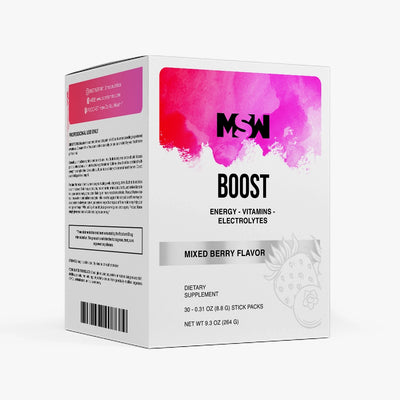
Here's the whole thesis in one line: you're not deficient in coffee, you're deficient in vitamins. Boost was built for exactly that gap — 2,500 mcg of methylated B12 with methyl B9 and B6, 500 mg of vitamin C, electrolytes and trace minerals, taurine, acetyl-L-carnitine, and S-acetyl-L-glutathione. The caffeine is paired with pterostilbene, which absorbs more slowly than caffeine alone, so you get steady energy instead of a spike and a crash. One stick in 6–12 oz of water. Five grams of carbs, zero sugar, berry or citrus — and a caffeine-free version if that's more your speed.
Grab Boost — Buy 2, Get 1 Free through July 31 →The 4 labs worth asking for
The reason this framework beats generic fatigue advice is that it's testable. Four inexpensive markers cover most of the ground above:
- Vitamin B12 — the obvious one, and still frequently low.
- Folate (B9) — ordered far less often than B12, despite deficiency being widespread.
- Homocysteine — rises when B6, B9, or B12 run low; elevated levels are linked to depression, dementia, and stroke risk.
- GGT — a proxy for glutathione status and oxidative load, useful even when it sits inside the normal range.
Vitamin D and iron are worth adding if they haven't been checked recently. Taken together, these tell you whether your methylation and antioxidant systems are keeping up — which is a far more useful answer than "your labs are normal, get more rest."
5 ways to start this week
- Get the four labs. B12, folate, homocysteine, and GGT. Ask specifically — folate and homocysteine are rarely included by default.
- Check the form, not just the name. If your B vitamins list "folic acid" and "cyanocobalamin," you may not be absorbing what you think. Look for methylfolate and methylcobalamin.
- Replace electrolytes on purpose. Not just water. If you sweat, work outside, or drink coffee daily, you're running a deficit plain water doesn't close.
- Feed your mitochondria protein and fat. Carnitine and taurine come primarily from eggs, meat, and seafood. If you eat plant-based, supplement them deliberately.
- Swap the second cup of coffee. The first cup is a habit. The second one is usually your body asking for nutrients it isn't getting.
FAQ
Why am I always tired even after 8 hours of sleep?
Sleep gives your body time to repair, but repair requires raw materials. If you're low in key nutrients — B vitamins, vitamin C, vitamin D, minerals, electrolytes — or your antioxidant and mitochondrial systems are struggling, you can sleep a full night and still wake up exhausted.
Which vitamin deficiency causes extreme fatigue?
B12 is the most well known, but folate (B9), vitamin D, and iron are also common causes. B6 matters too, since it's required to build the neurotransmitters that drive energy and motivation. Testing B12 and folate together, alongside homocysteine, gives a much clearer picture than B12 alone.
What blood tests should I ask for if I'm always tired?
Start with vitamin B12, folate (B9), homocysteine, and GGT, and add vitamin D and iron if they haven't been checked recently. Together these reflect your methylation status, antioxidant capacity, and the most common nutrient shortfalls behind fatigue.
Does coffee actually make fatigue worse?
Coffee is a diuretic, so it contributes to fluid and electrolyte loss. It also masks fatigue rather than addressing its cause. If you're relying on a second or third cup to get through the afternoon, that's usually a signal your body is short on nutrients, not caffeine.
What is MTHFR and how does it affect energy?
MTHFR is a gene involved in methylation — the process that converts folate into its usable form and recycles homocysteine. Variants can make it harder to process folic acid, which is why methylfolate, methylcobalamin B12, and methyl B6 are often better tolerated and more effective for energy and mood.
How do I support my mitochondria naturally?
Give them fuel and the tools to use it: adequate protein and healthy fat, carnitine (from meat and seafood or supplemented), vitamin C to support carnitine synthesis, and antioxidants like glutathione and pterostilbene to reduce the oxidative stress that damages mitochondria over time.
P.S. If you're sleeping enough and still exhausted, stop treating it as a character flaw. Fatigue is a signal, and it usually points at something measurable. Get the labs, fix the inputs, and give it 60 days. Grab the Boost Buy 2, Get 1 Free offer →